ITHAKA

ITHAKA

Sunday, December 14, 2014

Arriving in Venice, FL

Leaving our beautiful marina and resort in Longboat Key, we head out once again on the ICW for our next stop in Venice, FL.

It seems from all of our travels up the east coast, through New York and into Canada and down the inland river systems to the Gulf of Mexico and Florida, there have always been some very beautiful homes along the waterways we have traveled. Having said that, I think Florida still reigns supreme in the number and quality of beautiful waterfront property.

This "Little Glass House" just north of Venice on the ICW is just the latest example.


Great living, Florida style!


On arriving at Fisherman's Wharf Marina in Venice, we were soon greeted by more of our feathered friends that wanted to check us out while we were sitting on the Sundeck enjoying an adult beverage.

Sitting on a piling right off of our Sundeck is this Double-Crested Cormorant, cooling and drying itself off while spreading its wings.


All cooled off and looking pretty!


The great Brown Pelican. Known for its ability to dive from heights of 50 feet to catch fish, it has air sacs embedded in its neck and shoulder area to protect it from injury upon impact with the water.


It may not be beautiful, but the Pelican is one of the most efficient fishing birds around.

On to Sarasota, FL

Leaving Clearwater on a cool, cloudy morning, we took a short cut off the Intracoastal Waterway that took us along and parallel to the Sunshine Skyway Bridge across Tampa Bay.


The channel that led away from the ICW was narrow and only 6 feet deep, but well marked, so we decided it was worth it to cut the seven miles off of our travel distance for the day.


Arriving at our Marina in Sarasota, the Longboat Key Marina and Resort, we were parked across from the mega yacht, Entrepreneur. This is what she looked like in the day .......


..........and this is what she looked like at night with all her Christmas lights on.


The Marina is just one small part of this resort operation. This is one of the hotels and seven restaurants that are located throughout the property.


One of the many Christmas trees in the hotel lobby.


Of course no visit to a resort would be complete without going to the beach, so we went down to the beach on the Gulf to check it out.


After our visit to the beach, we caught the hotels' shuttle into the town of Sarasota. John Ringling, of the Ringling brothers circus fame, was one of the visionaries who helped develop the town in the early twenties, establishing many of the cultural and educational institutions that are located there today.

The Allegory of Sarasota and its Seven Virtues was dedicated in 2008 to commemorate the many gifts to the city by Ringling. Located in a circle, in the heart of the village, are seven marble statues, representing the Seven Virtues:
Music, Flora, Aristotle, Sculpture, Asclepius, Bounty and Amphritrite.


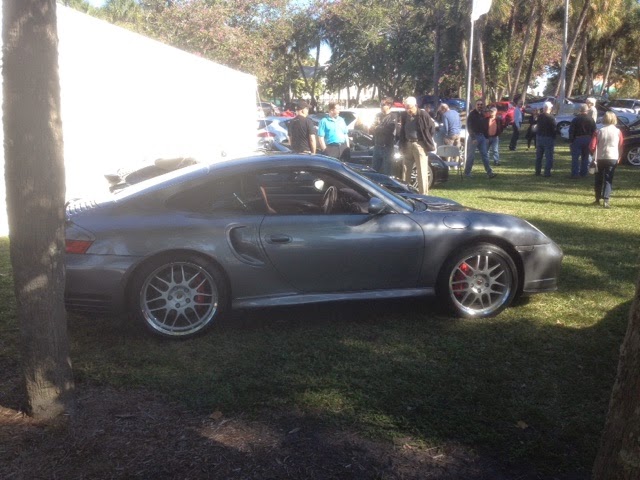
Of course, for those of us that are not so virtuous, there are PORSCHES IN THE PARK!!!!! On this particular weekend, the city sponsored a Porsche show and anybody who owned a Porsche was invited to bring their car down and show it off.


Being a former Porsche owner, this was truly some beautiful "eye candy" for the car lover.


Porsches of all styles and vintages were on display.


It seemed like almost everyone in Sarasota owned and drove a Porsche.


A Little R & R (Rest & Relaxation) in Clearwater, FL

After crossing the Gulf, we took a couple of days off to play tourist and to catch up on laundry, mail, etc. One of the towns we wanted to visit was Tarpon Springs. Tarpon Springs became famous due to the natural sea sponge business that started here in the late19th century by men that would go out in small boats and harvest the sponges with long rake like poles from the shallow waters. Eventually, Greek divers were enticed to immigrate to the area and used their expertise with deep sea diving to greatly increase the harvesting of the sponges. By the use of diving suits and helmets attached to the surface by an air hose, one diver could harvest four times as many sponges as a crew working from the surface in a small boat. Ultimately, the Greek divers took over the business almost entirely and their descendants still continue on today.

One of the many sponge boats with the sea sponges hanging out to dry after being cleaned. Note the Greek names on the bow.


The days catch waiting to go to market.


One of the many diver supply houses lining the water front.


The Anclote River in Tarpon Springs with the sponge boats tied up along the banks.


Christmas decorations along the Anclote River.


The Clearwater Harbour Marina, where we stayed after crossing the Gulf was a popular place for various "fishing" type birds to hang out on or near our boat while they were hunting for their next meal. They have obviously grown accustomed to people because we could walk very close to them before they flew off.

This little guy is a Green Heron. My bird book describes him as a small, stocky, solitary and secretive fishing bird. He sure liked hanging out around ITHAKA.


The Great Egret, on his favorite perch, our power cord.


The two fishing buddies. The Great Egret and the Great Blue Heron.


The Great Blue Heron scanning the waters for any unsuspecting fish. This is the sovereign of the wading birds, being up to four feet tall with a wing span of six feet.


One majestic bird.

Tuesday, December 9, 2014

The Gulf Crossing

Probably the last major hurdle on our Great Loop adventure is the open water crossing of the Gulf of Mexico. Depending on what point you depart from and what route is chosen, determines how long a distance must be covered and where you make landfall. For a boat of ITHAKA's size and draft, the preferred option is to do the crossing in one leg, crossing from either Apalachicola or Carrabelle directly to Tarpon Springs or Clearwater.
Our initial plan was to stage out of Carrabelle and cross directly to Clearwater, with the idea of finding a "buddy boat" that would travel at 10-12 mph to match the speed we intended to travel at. If we could not find that buddy boat, we planned to pass Twelve Stones and the group they were traveling with at 8 mph, knowing they were behind us on the same track and would be within radio range if we needed assistance. All the multiple forecasts we surveyed indicated that there would be a two day window on December 6 & 7 to cross safely, and that if we did not go then it would be another week before another one opened. The group of Loopers before us waited two and a half weeks before the weather was safe enough to cross. A "safe" window is considered to be winds 10 mph or less and seas less than 2 feet, with winds out of the North or Northwest. These conditions are hard to find during the winter months on the Gulf, which is what makes this crossing such an obstacle.

This is what the dock looked like the day before we were to move from Apalachicola to Carrabelle.


This is what it looked like the next day, so we changed our plans to stay at Apalachicola and depart from there instead of going to Carrabelle. The only problem with that plan was that December 6, the day of our departure, it looked the same way. The slow boat group decided to head out into the fog at 1100 while we waited until 1 PM to start out, hoping the fog would lift by then. At 1 o'clock, the slow boats were still in heavy fog but indicated it was showing signs of lifting, so we slipped our lines and headed for East Pass, just west of Dog Island, 28 miles away and the pass into the Gulf of Mexico. For the next two hours we proceeded along the ICW with visibility of less than 1/8 mile, sounding our fog horn as we went.


Finally, just before reaching East Pass and the open Gulf, the skies cleared and we powered up to catch and pass the group that was two hours in front of us.


Our luck and good weather did not last!!! Less than an hour after leaving East Pass, the fog rolled back in as thick as ever. Since the water was relatively flat and we had hopes the fog would lift the further off shore we proceeded, we continued on. After running at 12 mph for two hours, we caught up with the slower boats a half hour after sunset, still in HEAVY FOG! With no signs of the fog lifting and darkness settling in around us, we made the decision to fall in with the five boats traveling as a group and just settle in for a long, long night of "flying on instruments", or in this case "boating on instruments"! The five boats we traveled with were TWELVE STONES, with Russ and Elaine Sturm and Sea Dog Ike; ENDEAVOR, with John and his "crossing friend" Ken; AKASHA, with Clarke and Rosie Gillespie; PURA VIDA, with Steve and Sheli Sterk, and DREAM FEVER, with Andy and Cathy Robinson.

Sara at the helm as we were running fast to catch up with the five boats we know are out there in front of us because we see them on our radar. We just haven't spotted them with our naked eye yet!


Nighttime at the helm. Sara and I swapped out every couple of hours so the one not driving could try and catch a few zzzz's.


The Chartplotter, radar and AIS worked flawlessly all night.


The view out the front window, with the stern light of AKASHA visible 1/16 of a mile in front of us. If we let the distance increase beyond this, we would lose sight of them and have to catch back up on radar until we could spot their light again.


The morning finally dawned at 0710 while the fog lifted to reveal cloudy skies, winds increasing to 20 mph and seas increasing to 2 to 3 feet. At least the sun was not in our eyes and we could see the numerous crab pots as we drew closer to Clearwater.


PURA VIDA making her way in the Following Seas.


The Crossing is done!!! Time to celebrate!
After traveling 198 miles in 22 hours and 15 minutes, averaging 8.9 mph while traveling 18 of those 22+ hours in heavy fog, and being awake for thirty six hours, Sara and I slept for twelve hours then met up with most of the group at Cooters Restaurant Bar and Grill. All were present except for John's friend Ken, who had to get back to work. (He only came to help John cross). DREAM FEVER was not in attendance since they broke off early and went into Tarpon Springs.


Sara says, SHE WILL NEVER CROSS THE GULF AGAIN, IN A BOAT, AT NIGHT, IN THE FOG!!!

Friday, December 5, 2014

The Run to Apalachicola, FL

DAWN PATROL....
We normally do not "convoy" with other boats when we travel, but on this particular morning we slipped our lines and were out in the Intracoastal Waterway early enough to see the sunrise, along with Twelve Stones and Endeavor. Though we stayed with them for a short while, running at 7-8 mph was not something we wanted to do all day, so we powered up and headed out on our own. The stops after Orange Beach, AL took us to Niceville, FL, then Panama City, FL and finally Apalachicola, FL. We planned on moving on to Carrabelle, FL to stage out of there for our Gulf Crossing, but due to heavy fog this morning, December 6, we changed our plans and will leave from Apalachicola to cross the Gulf tomorrow, Saturday, December 7.


One of the many stands of Cypress trees that line the banks of the ICW (Intracoastal Waterway) in this part of northwest Florida. Large forests of these Cypress trees were common in the south, especially throughout Louisiana over a hundred years ago, but most have been logged over the years until few stands remain.


One of the most amazing things we have witnessed on this trip is the many encounters with dolphins swimming along beside us, either in our bow wave or our stern wake. Sometimes they just appear below the boat and sometimes they can be attracted by singing or slapping the side of the boat. Many times they will roll up on their sides as they are swimming along beside us and appear to be looking at us looking at them from the flybridge.


On this particular morning, we had not seen any for sometime. Suddenly we heard very loud FLOPPING or BANGING noises coming from somewhere in or around the boat. Sara and I were both on the flybridge and looked around trying to identify where the ominous sounds were coming from. We could not tell if it was coming from the engine or somewhere else on the boat. We just knew we had never heard it before. With no luck finding it from the flybridge, Sara went below to check further. From the sundeck she was able to see where the noise was coming from.


It was the Dolphins jumping completely out of the water and belly flopping back in the water. Time and time again. Whether they were catching their dinner or just having fun, we do not know, but it was a sight to behold!


They stayed with us for several minutes and then were gone as quickly as they had come.


The town of Apalachicola, Florida is now just a little sleepy fishing village that lies just off one of the inlets to the Gulf of Mexico. This town on the Apalachicola River was the third largest port on the Gulf of Mexico in the 1850's, third behind New Orleans and Mobile. At the height of their heyday, more than 140,000 bales of cotton were shipped from here to ports all over Europe.

The restaurant located at the marina where we ate most of our meals.


Since ITHAKA tied up a LONG way from the Marina office and restaurant, they were generous enough to loan us a golf cart to get to and from the boat and around town.


One of the only remaining cotton warehouses still standing. All the cotton bales were stored in buildings like this along the waterfront until they could be loaded on steamships.


The "Tin Shed", a unique nautical antique store.


The 37' Great Harbor trawler named Twelve Stones, tied up at the dock at Apalachicola. We have traveled off and on with them since Norfolk, VA.


The fuel docks the afternoon before we head out for our Gulf Crossing.