ITHAKA

ITHAKA

Monday, May 26, 2014

Long Stay In Deltaville

We left Waterside Marina in downtown Norfolk headed for Deltaville, VA on the Southern edge of the Western Shore of Chesapeake Bay on May 11. Our purpose for stopping at Deltaville was to pull into Zimmerman Boatyard, located at the Norview Marina and have some minor repairs done and have the hull and running gear checked for any damage that could have occurred when we touched bottom a couple of times coming into Fernandina, FL, some 700 miles ago. We did not suspect any damage because all preliminary checks verified that all systems were running normally. By having the boat "short hauled" and visually inspected, it would confirm our beliefs and give more peace of mind for the remaining 5000 miles of our journey.

After a long seven hour day running on a relatively calm Chesapeake Bay we pulled into the Zimmerman Boatyard and tied up for the night. Bright and early the next morning, Adam Sadag, the manager of Zimmerman Marine, and his Chief Mechanic Bruce arrived to get the process started.

A "short haul" is when the boat is lifted out of the water and left in the lifting slings just long enough for whatever needs to be worked on or inspected. Then, the boat is immediately placed back in the water.


The great news, when Ithaka was lifted out of the water, was that there was no evidence of any damage to any of the hull, propellers, rudders or supports. In fact, touching bottom had not even removed any of the bottom paint from the hull.


The not so great news was that while inspecting all the running gear, it was discovered that the four cutlass bearings on the drive shafts were showing enough signs of wear that it was Zimmerman's opinion that they be replaced. Since our goal is to keep the boat in tip top shape and correct minor problems before they become major problems, we decided to go ahead and have all four cutlass bearings replaced while several smaller minor repair tasks and upgrades were completed at the same time.


Bruce and Mike - Hard at work. 


Since Ithaka was now going to be placed "on the hard", meaning she would be out of the water and blocked up by support stands while all the work was being done, Sara and I decided to rent a car and relocate to the Hampton Inn in Gloucester, VA., about 40 minutes away. This would allow the work to proceed uninterrupted by us not staying on board (without A/C) and also give us an opportunity to see some of the sights we had intended to see anyway on our trip.

During the nine days Ithatka was on the hard, we had the opportunity to visit the world famous Mariner's Museum in Newport News, VA., where the first ironclad ship in the U.S. Navy, the U.S.S. Monitor is being conserved after being discovered and brought up from the bottom of the ocean in 2002.

Having fought to a draw in the first "battle of the ironclads" at Hampton Roads on March 9, 1862 the U.S.S. Monitor and the Confederate ship CSS Virginia (Northerners refer to her as the Merrimack) changed the course of naval warfare for all time. They proved in their four hour duel that the age of the wooden warship was a thing of the past.

Though the CSS Virginia would be scuttled by her own crew to prevent falling into Union hands, the USS Monitor sank off Cape Hatteras, NC during a storm in December of 1862, with 16 crew on board. It was not until 140 years later that she was discovered and the innovative 120 ton wrought iron  turret was brought to the surface, where it is currently undergoing conservation and restoration at the Mariner's Museum. 

One of the fascinating things about this trip is the amount of history we are traveling over and through as we journey North. From the early explorations of Florida, through the beginnings of the original thirteen colonies as we traveled through Georgia, South Carolina, North Carolina and Virginia and on into the Civil War period. 

Leaving Norfolk and navigating through the now busy Hampton Roads area, it does not take much imagination to recount the battle of the USS Monitor and CSS Virginia in this very place or to see John Smith sailing up the James River to found Jamestown.

Another attraction at the Mariner's Museum is the collection of wood ship models created by the master craftsman August Crabtree. Currently numbering over 2000 pieces, the collection contains models documenting nearly every type of vessel ever constructed. Working alone and sometimes as long as two years to create one model, Mr. Crabtree painstakingly carved, bent, painted and rigged each ship model.


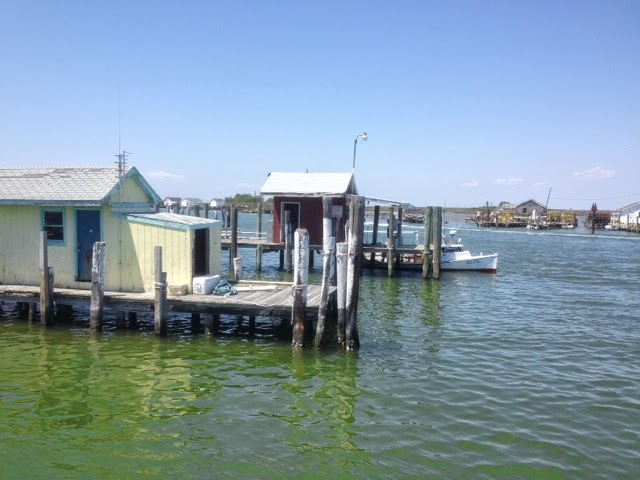
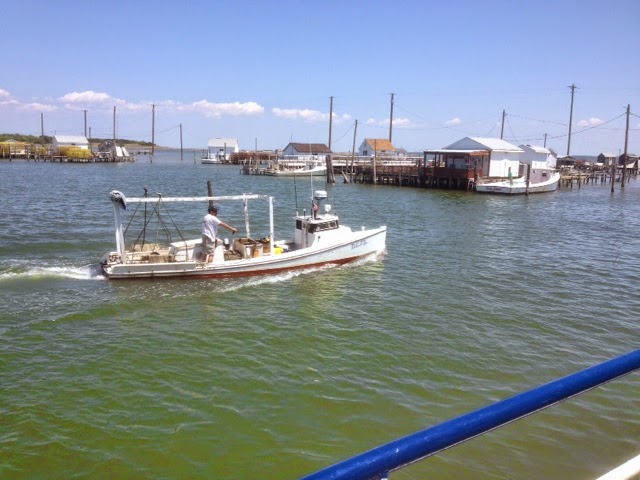
Another side trip we took was to Tangier Island, VA. This island sits in the middle of the Chesapeake Bay approximately 15 miles from the Western Shore of the bay and 18 miles from the Eastern Shore.

Ferry to Tangier Island

Though the island has a small airport, the only other access is by water and the ferry that runs once a day from Reedville, VA. on the west side of the Chesapeake and Crisfield,  MD on the east side of the Chesapeake. For almost 400 years this small community of approximately 500 people has existed as exclusively watermen. Harvesting the blue crabs and oysters from the local waters and selling their catches to the mainland. Because of their isolation, many of the islanders still speak with the Elizabethan accent of the earliest English settlers. Sadly, this unique way of life is rapidly coming to a close with the increased government regulations on crabbing and oystering. Tangier Island Watermen are finding it difficult to make a living. Combined with this fact is that the younger generation is choosing to leave the island and pursue careers in other fields. For the first time ever, no person graduating from high school on Tangier Island in 2013 decided to follow in his father's footsteps of becoming Waterman.

Meanwhile, back at the Zimmerman Boat Yard, the removal of the four cutlass bearings and replacement with new ones has taken place. The engines have been realigned to match the new cutlass bearing. Both stuffing boxes have bee repacked and the bottom has been pressure washed. All the running gear, to include the shafts, rudders and propellers have been repainted with bottom paint, all new zincs were placed on the running gear, a gauge for determining the fullness of the holding tank has been installed and numerous small maintenance items were completed. 

While all of this was being accomplished and the boat was on the hard, it gave me a chance to clean and polish the hull all the way to the waterline. One never realizes how large a 42' boat is until it is out of the water and a clean and wax job is done by hand!!!


After a short sea trial with Bruce, the Chief Mechanic, on board to check all the previous nine days work, we were finally ready to continue our journey. We would depart for Solomon, VA on the new day.

Wednesday, May 14, 2014

Norfolk to Deltaville

We left our "seems like home" of Waterside Marina in downtown Norfolk and continued on our Great Loop Journey this morning, Mother's Day, by cruising up the Elizabeth River and past "Warship Row" where several U. S. Navy warships of various design were either undergoing refit and renovations and repair or in the case of the Carrier, CVA U.S.S Ronald Reagan, being built.

Since I have been out of the Marine Corps for more than  27 years and was never great at ship identification, some of the ID's may not be completely accurate.

The first picture is one of our new destroyer type ships, followed by two pictures of the LHA's (Landing Helicopter Assault) ships which are designed to carry Marines, their amphibious assault vehicles and all their tactical aircraft/helicopters at one time. On the stern of the second LHA is a Harrier Jump Jet that is designed to take off and land vertically. The Marine Corps is the only U.S. service that flies the Harrier.


The last three photos of ships are of the CVA class of carrier. The CVA designates a ship as C Carrier V for fixed wing aircraft only and A for attack. These nuclear powered warships are the United States primary means of projecting power to any potential enemy. I believe the last picture of the CVA is of the new, under construction CVA the USS Ronald Reagan. It is sad that President Reagan did not live to see one of the largest and most powerful warships ever made be named in his honor.


Once through Norfolk and past Hampton Roads we were actually in the largest estuary in the U.S., the Chesapeake Bay. This is where we will spend the next few weeks exploring the many towns and villages on both the eastern and western shores.


After getting clear of the heavy shipping lanes and well into the bay, it was time to open up the throttles and bring the turbo charged engines up to speed, after several days running at basically idle speed through the Great Dismal Swamp and on into Norfolk with its many no wake or minimum wake zones.

The video shows me on the sun-deck looking over the stern as Sara drives the boat at a fast pace up the Chesapeake and past one of the many lighthouses that are still maintained in working order. This particular lighthouse happens to be the Wolf Trap light in the Southern Chesapeake.


Morehead City, NC - updated - video added

We arrived in Morehead City, NC on Good Friday, April 18th after a 64 mile run from Harbor Village Marina in Hampstead, NC. We pulled into the Morehead City Yacht Basin Marina on the Northwest side of the huge NC Shipping Terminal where all the ocean going container ships are tied up loading or off-loading their cargos.

Maneuvering into the fuel dock so as to take on fuel was another challenging docking experience. We were assigned a spot between two boats already tied up, combined with a strong NE wind of 15-20 mph and a narrow channel that required a 180 degree turn just prior to maneuvering into the spot. Luckily, all went as planned and we tied up, refueled, and settled in for the night.

The original plan was to spend one night in Morehead City and then move on to our next stop. Looking and listening to the marine forecast for the next day, with heavy rains and winds above 20 mph forecast, we knew we would be staying for at least one extra day.

When we started this journey, Sara and I mutually agreed that forecast winds of 20 mph or greater was cause for us to remain at the dock. If we were caught out in winds greater than 20, we could deal with it, but it made no sense to either of us to willingly go into those conditions, when we did not have to. As it worked out, we remained in Morehead City for the next three days because the same weather system continued to create heavy rains and strong north, northeast  winds of 25mph gusting 40 mph.

Being tied to the fuel dock with our port side (that's the left side for you land lubbers) exposed to the strong winds we spent the next three days and nights rocking and rolling to the wind driven waves. Checking and rechecking our lines and placement of the fenders to keep us from crashing into the fuel dock became a several times a day ritual. Fortunately, all our lines held and our fenders stayed in their proper places. Speaking with the Dock Master on the third day, some boats broke loose from their lines and beat themselves against the dock causing major damage before they could be resecured.

The highlight of Easter Sunday was being able to walk, in the gale force winds and rain, to Floyd's 1921 Restaurant that was less than a block from our marina for their Easter Sunday Buffet. Once back on the boat we settled in for a long night of rocking and rolling and listening to the waves slap against the hull.

With the weather finally appearing to be breaking, we plan on departing Morehead City tomorrow morning the 22nd of April.

Jack made a video of the fenders blowing in the gale wind. It has taken me a while to reteach myself how to upload videos from the IPHONE to Blogger.


Rainy Easter Sunday. 


Monday, May 12, 2014

April 28th - May 11th Extended Stay in Norfolk

After the Dismal Swamp, we tied up at Waterside Marina In Norfolk Va. for about two weeks. We arrived there early for the AGLCA (America's Great Loop Cruising Association) Rendezvous. I flew back to Indiana for a couple of days for a family event.

My daughter's family  (Erin, Chad, John, Ben, Katie) and son's family (Ryan, Laura, Casey, Davis) picked me up at the Evansville Airport.

Here they come. Running to greet me.  Each grandchild was carrying a yellow rose.
It put a smile on my face and brought a tear to my eye.

This weekend was Katie's (granddaughter) First Communion. 


Ryan (son), Laura (daughter-in-law) and their girls (Casey and Davis) came from the Louisville, Ky. Area to be a part of the fun.


As you can see, it is difficult keeping small children and young men entertained, while waiting for the First Communion to begin. 

Jack stayed in Norfolk and worked on the boat. We are changing the saloon ceiling lights and red step lights to LED. He also cleaned the boat for the AGLCA Trawler Crawl. The Trawler Crawl is held 3 afternoons, during the rendezvous. You can sign up to open your boat for viewing. Boaters attending the rendezvous  may tour your boat from 3:30 - 5:00.
 WOW! Look at the GREAT job Jack did! He made her shine!


Jack takes a break...

One of the days Sara was back in Indiana for her granddaughter's First Communion, I took a break from cleaning the boat and drove to the archaeological dig site at the original Jamestown Landing of 1607.

For more than three centuries, historians thought the site of the original fort, built in 1607, as well as the church and several other buildings, had been covered by the James River and were lost forever.

In 1994, a non-profit organization consisting of several renown historians, scientists and archaeologists persuaded the federal government and the state of Virginia to allow them to dig for artifacts in a 22 acre plot of land that was privately owned. Their goal was to uncover several hundred artifacts to help in the celebration of the 400th anniversary of the Jamestown landing.

Their success has exceeded everyone's expectations. To date, more than several million artifacts have been uncovered, as well as the foundation of the original fort, the original church, several buildings used for meetings, and eating places. In addition, several complete sets of human remains and skeletal remains buried in coffins have also been found.

The first picture shows the guide standing inside of the outline of what was the original church that was erected in 1607/08. This site has already been excavated and the earth placed back over the evidence of the foundations as well as the alter. He is standing over the site of the four skeletons that were found buried under the alter. Though DNA has not positively identified the four individuals yet they do know they were all high ranking men from the settlement because only highest ranking personnel were afforded the honor of being buried not only inside the church but under the alter as well. They have also been able to determine that all four men were from England because their DNA showed they had eaten a wheat, not corn, base diet and that they had eaten off of lead/pewter plates most of their lives instead of wood utensils, etc. Their hope is that with more testing they will actually be able to trace the identity of the four individuals.


The second and third pictures show the guide standing over the excavated site of the public building/meeting house/inn where the archaeologists have worked down to the basement level where the ovens for cooking have been uncovered. They have also found evidence of cannibalism that was alluded to in some of the original writings of John Smith. He referred to the winter of 1608/09 as "the starving time." It was during this winter that the settlement, which had grown to some 340 people, was decimated by the harsh winter, the attacks of the local Native Americans (that had stopped supporting and trading with the settler), and sickness. By the spring of 1609 when the first resupply ships arrived from England, the settlement had withered away to 68 people. The evidence uncovered to date consists of several skeletal remains with tell tale marks of sawing or cutting of the human bones as well as the destruction of the skulls with blunt instruments to open up the cranium.


The fourth picture is an accurate depiction, based on archaeological evidence obtained from the site of how the original fort of three sides actually looked in 1607. By 1609/10, the settlers had improved and strengthened the fort to five sides, because they were coming under increasing attacks from the Native Americans.


The last two pictures are of the statue of John Smith the driving force behind the successful establishment of Jamestown as the first, permanent, English settlement in what was to become the United States. The statue overlooks the actual landing area of the first three ships that traveled up the James River in 1607 and tied their ships to the trees on shore instead of having to anchor out in mid stream.


The AGLCA Rendezvous filled Waterside Marina with sailboats and trawlers. Many of these boats have completed the "Great Loop" or will complete the loop this year. We will hopscotch around the loop from marina to marina with many of these fine people.  Hopefully, making life long friendships as we go.


The rendezvous sessions were held in the Sheraton Hotel next to the Waterside Marina. Great presentations, food, and fun. We were one of the last boats to leave the marina. 
We move on to discovery the Chesapeake Bay Area and more memory making moments.

Tuesday, May 6, 2014

Dismal Swamp Canal


About halfway through the Dismal Swamp Canal, you can tie up at the visitor center face dock for up to 48 hours. The dockage is tight and we had to raft up to a sail boat. This is a State Park with lots to see and do. 

Jack and I were a little disappointed. From what we read about the Dismal Swamp Canal, we were expecting a more remote, isolated, area. Most of the way through the canal we could hear and see 18 wheelers buzzing by on the highway that parallels the canal. 


How would you like to meet this guy (dredger/stump remover) coming the other way on this very narrow canal?


Goodbye Dismal Swamp
On to Norfolk, VA and the AGLCA Rendezvous. Four days of very bad weather are predicted. It has really turned cold again.